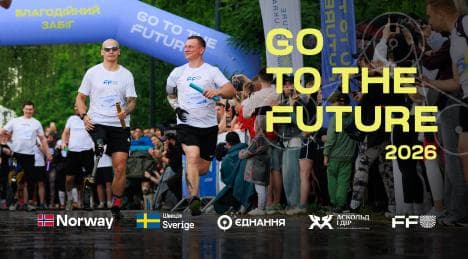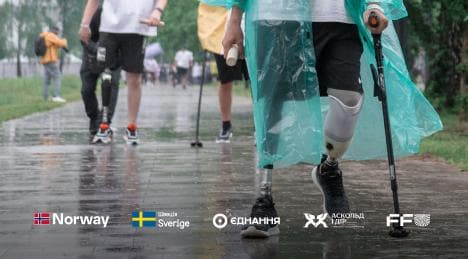
A new series of events organized by the Future for Ukraine charitable foundation has kicked off at the International Center for Orthotics and Prosthetics, MCOP Ukraine. Veterans and specialists are working together to find practical ways to cope with everyday challenges that come up when returning to civilian life.
How should you respond when a stranger at the store asks something impolite? How do you talk to people who have no shared experience? These questions became the starting point for the first session of the "Go to the Future: Advocacy for Barrier-Free Integration of Veterans with Limb Loss" project (supported by the Askold and Dir Foundation, administered by ISAR Ednannia under the "Strong Civil Society of Ukraine" project, funded by Norway and Sweden).
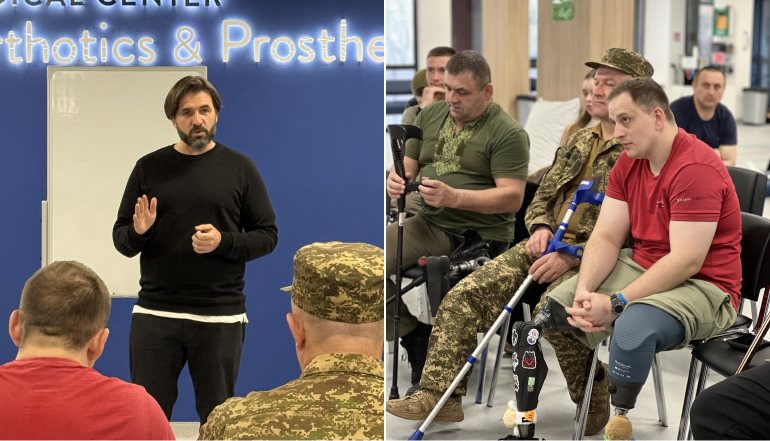
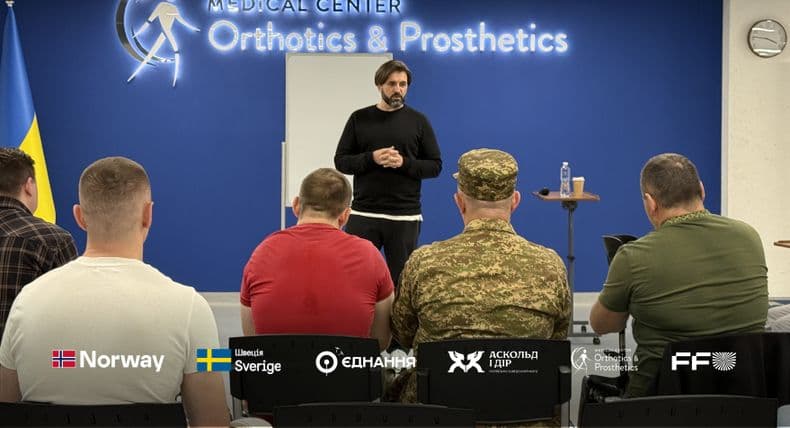
More than 20 patients from the center and their family members attended the event. This session opened a four-part series of public discussions, each focused on a different dimension of reintegration.
Why this format matters
According to the Ukrainian Veterans Foundation, 58% of veterans feel a lack of understanding from society. That's not an abstract statistic. It's the daily reality for people recovering from amputations, rebuilding their social connections from scratch.
To give veterans concrete tools for such situations, the organizers invited Yurii Kliatskin, a director and adaptive intelligence trainer. No more theory. Participants jumped straight into real-life scenarios: conversations at a store, at work, with family. Improvisation techniques help people find inner stability and act with confidence even in stressful situations.
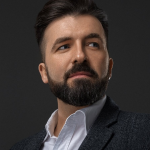 Yurii Kliatskin
We drew on the principles of stoicism and improvisation, approaches that teach you to accept reality and move toward your goals regardless of limitations. Real limits only exist in our heads. I was struck by the inner strength of these men. They went through enormous hardships but kept their optimism and, importantly, their sense of humor
"You have to get up and keep going."
For many participants, the session was more than training. It was the beginning of a shift in perspective. One of them was 31-year-old National Guard soldier Dmytro Kolesnyk, call sign "Staryi." After a double leg amputation, he went through prosthetic rehabilitation in the US through an FFU program and is now working on launching his own clothing line.
"Today I understood what I'm going to do next. The idea that you have to take risks and go after your goal really resonates with me. No matter how hard it gets, you have to get up and keep going. I was happy to see friends and feel that support," Dmytro shared.
What comes next?
Prosthetics are the beginning of recovery, not the end. To return to an active social life, veterans need real reintegration tools. The next three sessions in the series will cover returning to sport, professional retraining, and sexual literacy.
The initiative is part of a shared strategy between FFU and MCOP Ukraine to build an environment where veterans with amputations not only receive medical care but also develop their own voice in society.
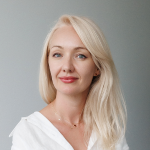 Olena Nikolaienko, President of Future for Ukraine (USA).
We are working to build a systemic support model where a veteran gets not just a prosthetic limb but also an environment for rebuilding social connections and taking an active part in public life. Our goal is an inclusive environment where veterans stay engaged and visible
The material is produced by CF «Future for Ukraine» with the support of the Askold and Dir Fund as a part of the Strong Civil Society of Ukraine - a Driver towards Reforms and Democracy project, implemented by ISAR Ednannia, funded by Norway and Sweden.
The contents of this publication are the sole responsibility of CF «Future for Ukraine» and can in no way be taken to reflect the views of the Government of Norway, the Government of Sweden, and ISAR Ednannia.