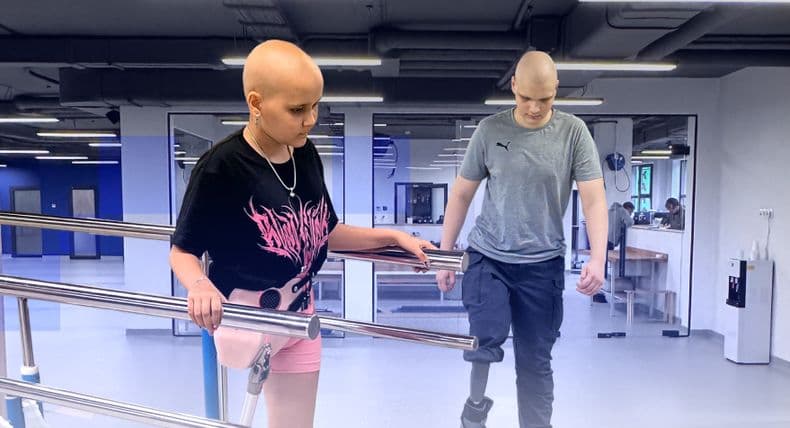
Vira and Bohdan share more than the experience of living through a serious illness and its consequences. More than anything, they want to walk again and be active. That is why they turned to Future for Ukraine’s prosthetics program.
Eleven-year-old Vira is rediscovering childhood — playing, riding a bicycle, and doing the things she loves. Sixteen-year-old Bohdan can once again visit his friends on his own. On one occasion, he even carried home a parcel weighing 14 kg, much to his parents’ surprise. Not long ago, these things seemed impossible after cancer led to high-level leg amputations. Their desire to do what other children do — walk, run, and ride bicycles — keeps motivating them to persevere and learn to use their prostheses.
Prosthetic care for children became possible at Future for Ukraine after the foundation expanded access to its lower-limb prosthetics program to all Ukrainian citizens — veterans and civilians — who have undergone amputations since February 24, 2022. The “Iceland Supports Mobility in Ukraine” program is implemented in partnership with Medical Center Orthotics & Prosthetics (MCOP) Ukraine and will provide free lower-limb prostheses to around 1,000 Ukrainians.
Just like other children: Vira’s story
Until the age of 11, Vira was a healthy, active child. She took ballroom dance classes, rode her bicycle, played at the playground, and ran around with other children. Then her knee began to hurt.
At first, her parents did not suspect anything unusual. Vira was always on the move, so it was easy to attribute the pain to a bruise or an awkward movement. They consulted doctors and had X-rays and ultrasound scans, but these did not lead to the correct diagnosis. Only an MRI revealed that Vira had osteosarcoma — a malignant bone tumor. By then, the delay in diagnosis meant that her limb could no longer be saved.
Vira underwent chemotherapy, followed by a high-level amputation. The first months after surgery were difficult. She used a wheelchair and crutches at home. The hardest part was the phantom pain: it was so severe that neither special exercises nor the other methods her family tried provided relief.
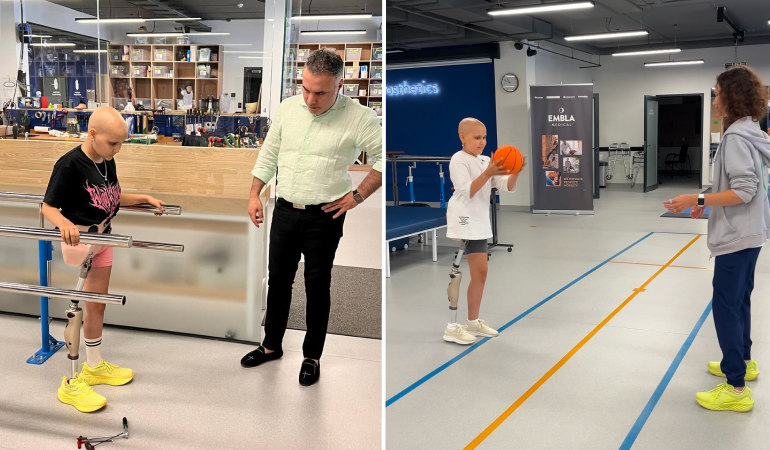
Vira wanted to get a prosthesis as soon as possible. Her first was a training prosthesis with a temporary socket. Because of the complexity of her amputation, it caused discomfort. To have it adjusted, her family had to travel from the Poltava region to Kharkiv — a five-hour journey each way.
Vira later received a modern prosthesis with an electronic knee joint at MCOP Ukraine, with support from Future for Ukraine. For her, this meant more than greater comfort when moving. The new knee allowed her to walk down stairs and slopes more safely, making her more independent.
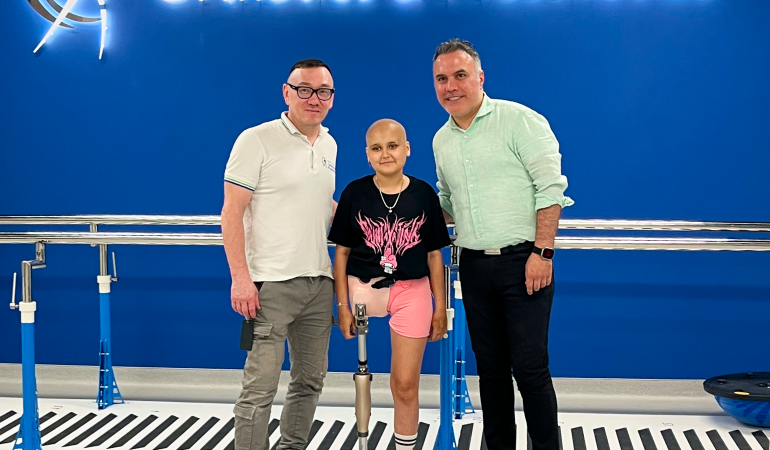
“When my daughter wants to try something, we give it a go. If she wants to ride a bicycle — okay, we’ll try riding a bicycle. If she wants to ride a scooter, we’ll try that too. What matters most to me is that she doesn’t feel limited and can do the things she wants to do,” says Olena.
With her new prosthesis and professional support as she learns to use it, Vira is returning to her favorite activities, playing with other children, and enjoying childhood. The foundation can support Ukrainians on this journey thanks to its partners, donors, and Vadym Stolar, a longstanding patron of Future for Ukraine’s charitable projects.
Learning to use a prosthesis while undergoing chemotherapy: Bohdan’s story
Bohdan is 16. Before his illness, he practiced weightlifting. In September 2020, he began experiencing pain in his leg while doing weighted squats. At the time, examinations found no physical or neurological problems. The pain was attributed to a training injury.
Three years later, Bohdan’s condition began to worsen. Frequent fevers and weakness prompted his parents to seek further medical investigations. It was another year and a half before doctors diagnosed an aneurysmal bone cyst, which led to a below-knee amputation in October 2025.
But his difficulties did not end there. In December 2025, further examinations revealed a tumor. A second amputation was needed, this time above the knee.
Bohdan has been undergoing cancer treatment since December 2025, which makes his rehabilitation considerably more difficult. Even so, he remains determined to learn to use his prosthesis alongside his treatment.
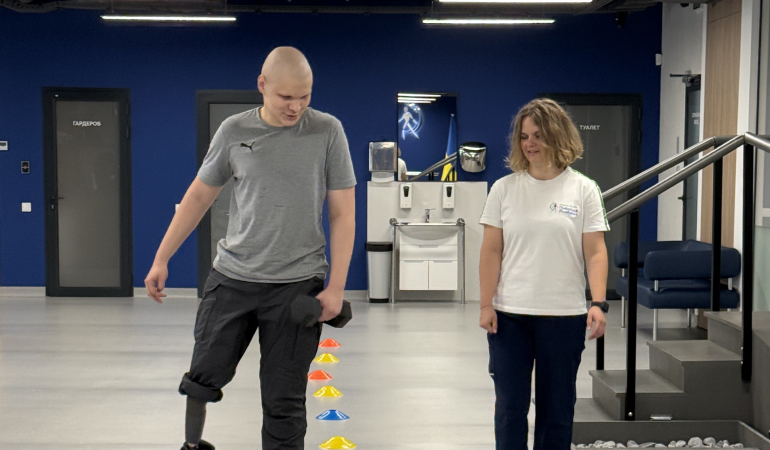
“Progress is not always quick, because the medication Bohdan takes causes swelling and affects how he feels. There are days when he feels well and his limb volume is stable enough for the prosthesis to fit properly. But there are not always enough of those days to see rapid progress within three months of using a prosthesis,” explains Veronika Kravchenko, a physical therapist at MCOP Ukraine.
At first, Bohdan practiced walking between parallel bars with help from physical therapists. Once he had mastered the movement needed to bring his prosthetic leg forward, he progressed to crutches. Today, Bohdan walks without mobility aids and can cover up to 5 km when he feels well. What he had dreamed of throughout those years of treatment has become a reality. He goes for walks and meets his friends again. On one occasion, he even went to the post office on his own and carried home a parcel weighing 14 kg, much to his parents’ surprise. Bohdan is now completing his course of physical therapy and preparing to receive a permanent carbon-fiber socket.
“Losing a limb is not the end of life. It is the beginning of a new life, with its own challenges. But it is still life, and we must not lose hope. We need to do everything we can to help our children feel happy,” says Olena, Vira’s mother.
Free lower-limb prosthetic care for 1,000 Ukrainians: how to apply
Free prosthetic care is available to all Ukrainian citizens who have undergone a lower-limb amputation since February 24, 2022, regardless of the cause — combat injuries, illness, road traffic accidents, other accidents, or any other circumstances.
The program offers primary prosthetic care for people receiving their first prosthesis and secondary prosthetic care for those who need to replace an existing prosthesis or its components because they are no longer fit for use, cause discomfort, or do not meet the user’s needs.
To apply for free prosthetic care, complete the application form and attach documents confirming your identity, the need for prosthetic care, and the fact and level of amputation. Full lists of the documents required for military personnel and civilians are available on the project website.