Today, more than 100,000 people in Ukraine — both military personnel and civilians — are officially considered missing as a result of russia’s full-scale invasion. Behind every missing person is a family living between hope and uncertainty. Most often, it is women — wives, mothers, partners, and sisters — who continue to hold their families together, raise children, manage everyday responsibilities, and struggle not to lose themselves while waiting for news.
Psychologists describe this experience as ambiguous loss — a state in which there is neither confirmation of life nor death. Without certainty, people cannot fully grieve, yet they are also unable to return to everyday life. It is one of the most complex forms of psychological trauma and requires long-term, compassionate, and professional support.
This is exactly the kind of support provided through GIDNA, Future for Ukraine’s psychological assistance program, which offers free individual therapy sessions to help people find stability and resilience while living with uncertainty.
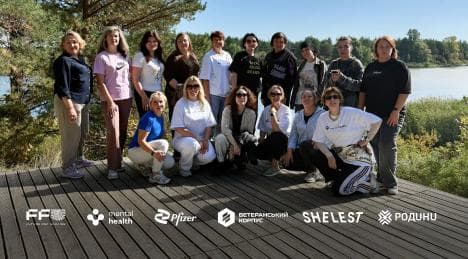
To strengthen support for women experiencing ambiguous loss, Future for Ukraine’s GIDNA project joined forces with the Ensign Service of the 12th Special Forces Brigade “Azov” of the National Guard of Ukraine. Together, the teams organized the “Vidnova” charity retreat camp in Ukraine’s Zakarpattia region for families of missing persons.
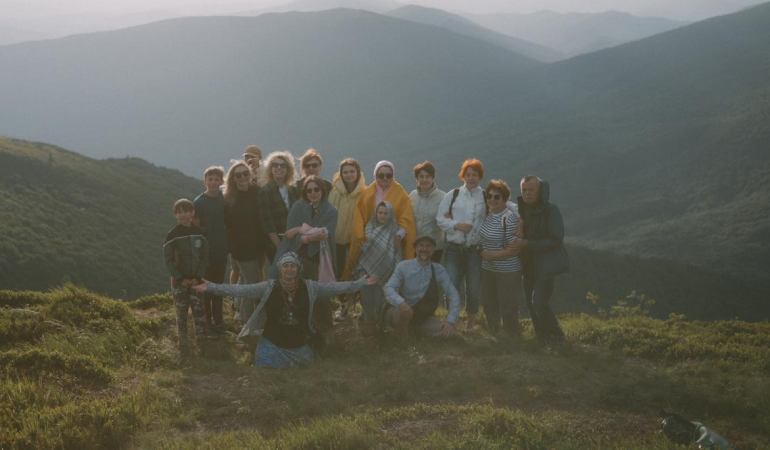
The retreat brought together women who regularly attend psychological support groups organized by GIDNA and the Ensign Service, as well as members of their families.
From June 30 to July 5, in the village of Poliana in Zakarpattia, mothers, wives, and sisters of missing service members spent several days in an atmosphere of calm, safety, and understanding — a place where they could finally allow themselves to rest, laugh, and care for themselves without guilt.
These retreats are far more than temporary getaways. They are an essential part of comprehensive psychological support for women living with ambiguous loss. They offer an opportunity to step away — if only briefly — from the constant strain of waiting, restore emotional strength, and spend time among people who understand without explanation.
“The purpose of the retreat was to create an alternative community — or even a new psychological family — where women could rely on people who allow them to express emotions freely, remain silent when they need to, or share what has been weighing on them. The participants formed close bonds, continue to stay in touch, call one another, and still lean on us for support. That tells us the support does not end when the retreat is over,” says Nataliia Shapoval, psychologist with the Ensign Service of the 12th Special Forces Brigade “Azov.”
The “Vidnova” retreat was unlike traditional therapy. Through Ukrainian female archetypes, mythology, nature, movement, and shared practices, psychologists gently helped participants reconnect with themselves.
“Step by step, we worked with emotions, inner resilience, and personal boundaries. Only then did we begin talking about the future. For many women, even imagining tomorrow had become almost impossible. By the end of the retreat, they wrote down small personal plans — for a week, two weeks, or a month ahead. It was an incredibly important moment,” says Lidiia Dulnieva, psychotraumatologist and psychologist with the GIDNA project.
Throughout the retreat, participants gradually found the strength to move forward despite pain and uncertainty, gave themselves permission to keep living, and began to see the possibility of a future once again.
For many women living with ambiguous loss, allowing themselves to rest, laugh, admire the beauty of the mountains, or simply take care of themselves had felt impossible for years because of overwhelming guilt. Yet self-care is exactly what helps preserve the inner strength needed to continue waiting, support their children, and remain a source of stability for their families.
“For example, Maryna absolutely loved the variety of fresh vegetables served at breakfast and started making herself a plate exactly the way she wanted every morning. It may seem like a small thing, but in reality it was the first act of self-care she had allowed herself in a very long time. And that meant she had chosen life again,” Nataliia Shapoval recalls.
One of the warmest memories participants took home was an evening spent high in the mountain meadows.
“When we reached the mountain pasture at sunset, freezing from the cold, I saw people truly reconnecting with life. Someone wrapped another person in their jacket, someone gathered wildflowers, the children simply laughed and played. Later that evening, sitting around the fire and sharing a warm dinner, I felt something I hadn't experienced in a long time — a genuine sense of family. The kind where you can simply sit together in silence and still feel that you belong,” one participant recalls.
What made the “Vidnova” retreat unique was the partnership between two teams: Future for Ukraine's GIDNA project, which specializes in supporting people experiencing ambiguous loss, and the Ensign Service of the 12th Special Forces Brigade “Azov,” which has many years of experience supporting military families.
“The fact that these women agreed to travel together at all was the result of deep, systematic psychological work that had begun long before the retreat,” the organizers explain.
Every part of the retreat was carefully designed with the participants' needs in mind. Combined with the peaceful surroundings of the Carpathian Mountains, it created a safe space where women could simply exist, process their emotions, and reconnect with life.
The participants were also supported by Ukrainian brands Bazhane, Lamel, and Intime Organique, which prepared thoughtful gifts for every woman, including capsule wardrobe pieces and cosmetic sets. These gestures served as another reminder that caring for yourself is neither a sign of weakness nor a betrayal of those you are waiting for. It is an essential condition for enduring.
Although the “Vidnova” retreat has come to an end, the healing process continues. Regular psychological support groups first help women give themselves permission simply to exist, then to speak openly about their experiences. The retreat became the next step—giving them the opportunity to truly feel life again.
“Instead of constantly looking back and longing for the life they once had, the participants allowed themselves to accept a different life — one that includes pain, loss, uncertainty, with or without the person they are waiting for. Living with ambiguous loss does not mean forgetting. Feeling life again is not a betrayal; it is an act of self-care. And they gave themselves permission to do that,” concludes Lidiia Dulnieva, psychologist with the GIDNA project.
If you or someone close to you is living with uncertainty, you can receive free psychological support and become part of the GIDNA community. Simply fill out the application form on our website or call +38 (050) 722-89-13.
We sincerely thank Bazhane, Lamel, and Intime Organique for supporting this retreat and helping make it possible. We are also grateful to the Ensign Service of the 12th Special Forces Brigade “Azov” of the National Guard of Ukraine for their partnership in bringing this important initiative to life.