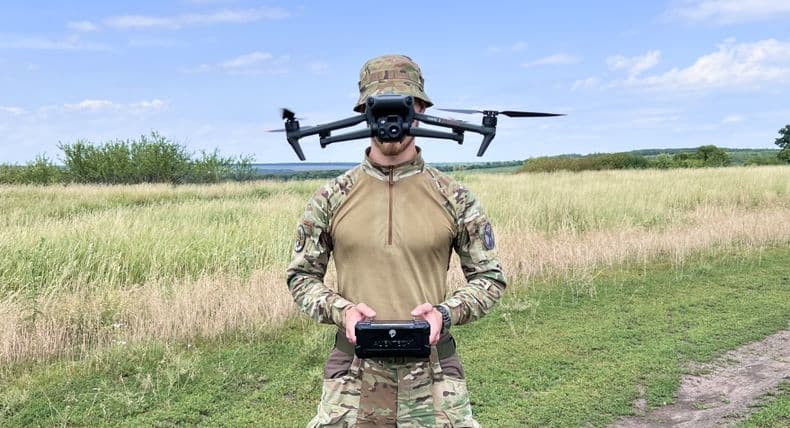
Oleksandr is 24. He lost his right arm and left leg in an FPV drone attack on the Kharkiv front. Yet even after undergoing double amputation, he refused to give up an active life. Today, he swims, plays basketball, renovates his home, and studies 3D modeling.
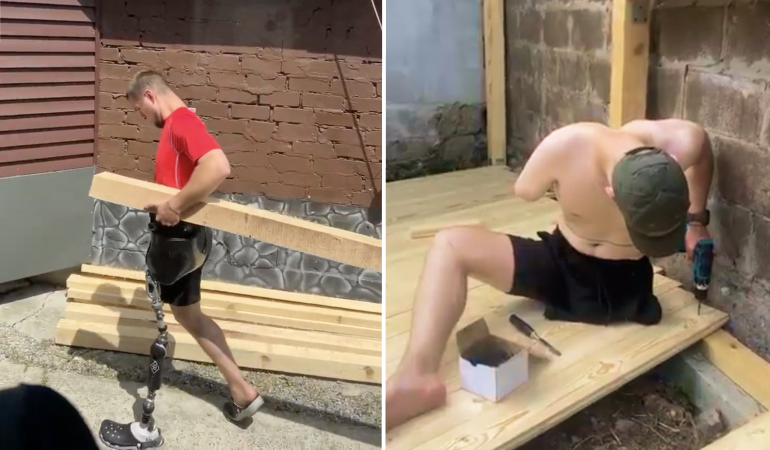
The prosthetic care and rehabilitation program provided by MCOP Ukraine together with Future for Ukraine helped him regain confidence in himself and his future. Future for Ukraine’s charitable programs, including support for veterans on their recovery journey, are made possible through the ongoing support of the Foundation’s patron, Vadym Stolar. Oleksandr is already looking ahead: he has applied to Lviv Polytechnic National University to study bionic technologies — a field that is becoming increasingly important in Ukraine. This autumn, he hopes to return to military service to train new soldiers. Just a year ago, however, his only goal was to survive.
Oleksandr Holitsyn was in Saltivka, a district of Kharkiv, when russia launched its full-scale invasion. At first, he planned to evacuate to western Ukraine, but soon realized he could do more by staying.
“I got on my motorcycle and reached my hometown of Kupiansk in five hours. That evening, I told my parents I was going to volunteer for the army. My mother burst into tears. I never wanted war, but the Russians came to our home with weapons. We had no choice but to defend ourselves.”
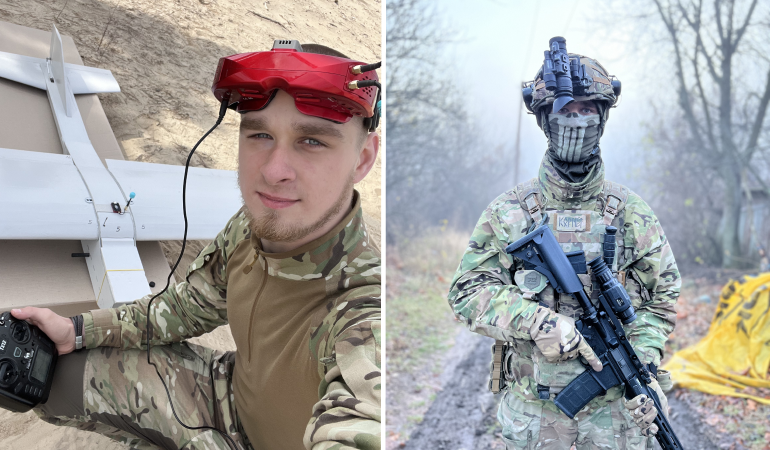
The very next day, Oleksandr joined the Armed Forces of Ukraine as an external UAV pilot. For the next three years, he carried out combat missions in eastern Ukraine until May 2025, when an enemy FPV drone changed his life forever.
“It happened on May 9, during the so-called ‘ceasefire.’ I was escorting an engineering unit to fortified positions. On our way back, the driver switched on the low beams. Suddenly, we saw an FPV drone flying straight at us. I managed to cover my face, but the blast tore off my arm. The shaped-charge jet severely injured my leg and ruptured an artery. A tourniquet was applied immediately.”
The soldiers were left without a vehicle or radio communication. Fortunately, another unit happened to be passing nearby and evacuated Oleksandr to a stabilization point.
Doctors in Kharkiv had to amputate his leg after his kidneys began to fail. Severe inflammation prevented them from connecting him to dialysis.
A week later, he was transferred to an intensive care unit in Kyiv. Throughout that time, his family had no idea whether he was alive. At five in the morning, Oleksandr asked a doctor for a phone so he could finally call his mother. He could barely find the words to tell her about his amputations.
“I said, ‘Mom… there’s something I need to tell you.’ She laughed and replied, ‘I already know. Your brothers-in-arms called me. The way you're saying it, though, you'd think you had just broken a cup.’”
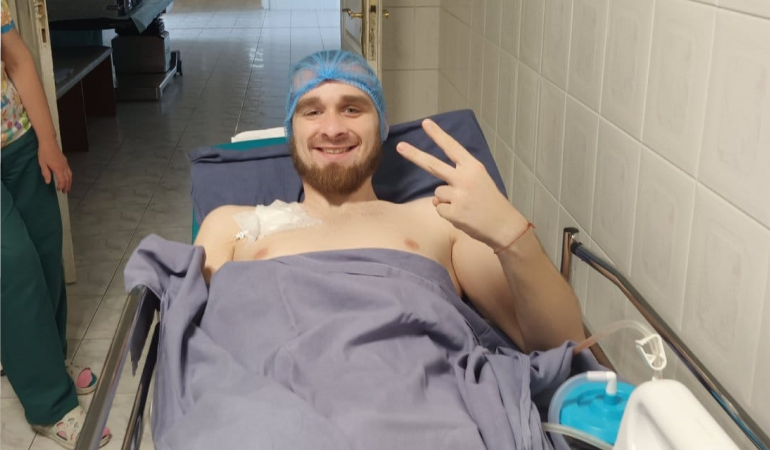
Over the next six months, Oleksandr underwent seven surgeries, including revision amputations of both his arm and leg. Surgeons had to remove his elbow and perform a hip disarticulation to prepare him for advanced prosthetic fitting. At the time, he knew very little about modern prosthetic technology, but he was determined to regain his independence.
“I learned everything from ChatGPT and YouTube. Then, at the hospital, I met other veterans who told me about the opportunity to receive prosthetic care at MCOP Ukraine and join Future for Ukraine’s Gait Adaptation and Optimization Program. I decided to give it a try. Before I was injured, I had always been active — and I wanted to stay that way.”
Today, Oleksandr uses a state-of-the-art lower-limb prosthesis, fitted free of charge at MCOP Ukraine. The prosthesis features a microprocessor-controlled knee that makes walking safer and more stable, tracks his steps, and adapts to his individual gait.
Alongside prosthetic fitting, Oleksandr completed Future for Ukraine’s Gait Adaptation and Optimization Program (GAOP). This comprehensive approach helps patients not only receive an advanced prosthesis but also learn how to use it safely and confidently in everyday life through guided physical rehabilitation.
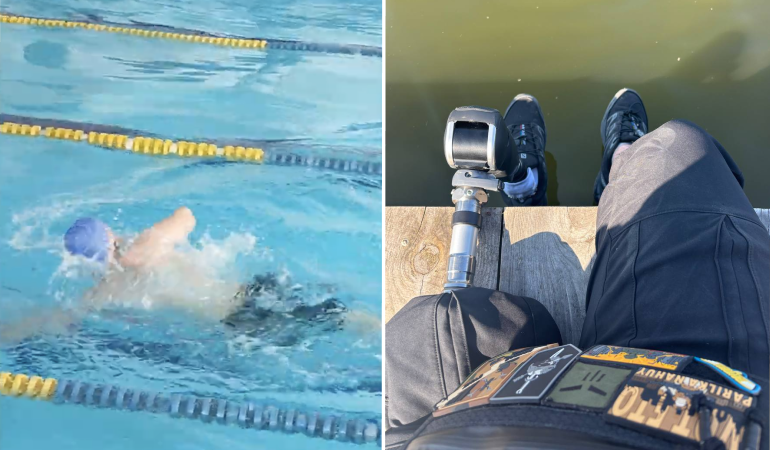
“In just six months, my prosthesis has already logged 200,000 steps — I can see it in the mobile app. I do home renovations on it, run errands, and even drive a car.”
Next, Oleksandr is planning a trip to Germany. He wants to visit the Audi Museum and experience the Nürburgring racetrack in person. A lifelong car enthusiast, he hopes to immerse himself in motorsport culture.
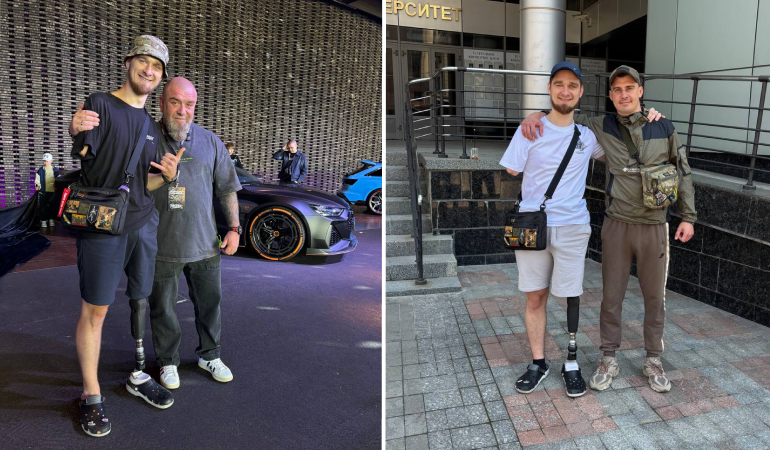
This autumn, he also plans to return to military service, where he will help train new soldiers. At the same time, he will begin studying bionic technologies at Lviv Polytechnic National University, determined to better understand the innovations that are transforming the lives of people living with limb loss.
“I enjoy every single moment of my life because I survived this war. That means I have to keep moving forward and never give up,” Oleksandr says.
Future for Ukraine helps Ukrainians living with limb loss receive advanced prosthetic care and professional gait adaptation support free of charge.
Applications for the Foundation’s lower-limb prosthetics program are now open. The lower-limb prosthetics program for Ukrainians is being implemented with grant support from the Government of Iceland and Embla Medical HF. Learn more and apply here.
You can also support Ukrainian defenders recovering from amputations by making a donation on the Foundation’s website. Every contribution helps another person regain mobility, independence, and the opportunity to return to an active life.