Future for Ukraine presented the findings of the study “Assessment of Environmental Accessibility for War Veterans with Limb Loss in Ukraine,” based on responses from 204 Ukrainian veterans.
The study shows that receiving a prosthesis is an important step in recovery, but a prosthesis alone does not guarantee independence. Outcomes are also influenced by access to rehabilitation and prosthesis maintenance, transportation, housing, employment opportunities, mental health support, and participation in community life.
“Having a home of my own, transportation, and a good job would help me feel as independent as possible, because right now I depend on other people for these things,” one respondent wrote.
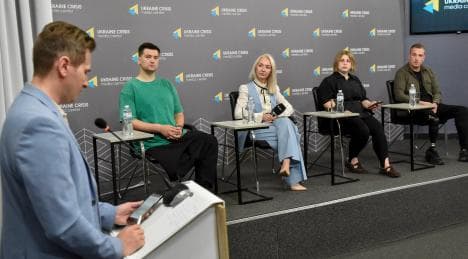
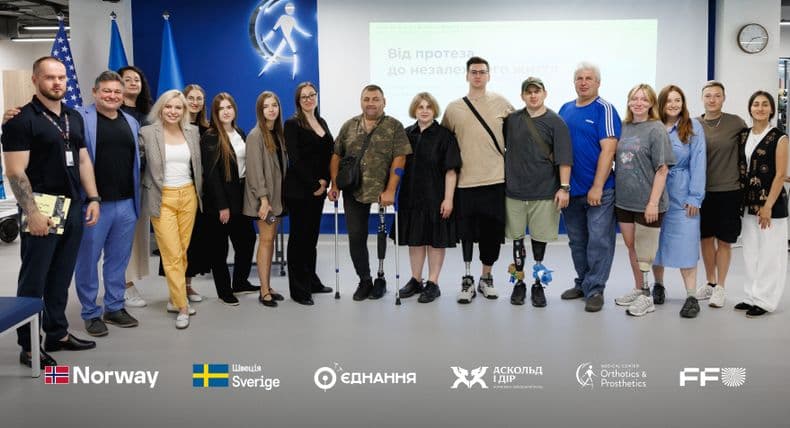
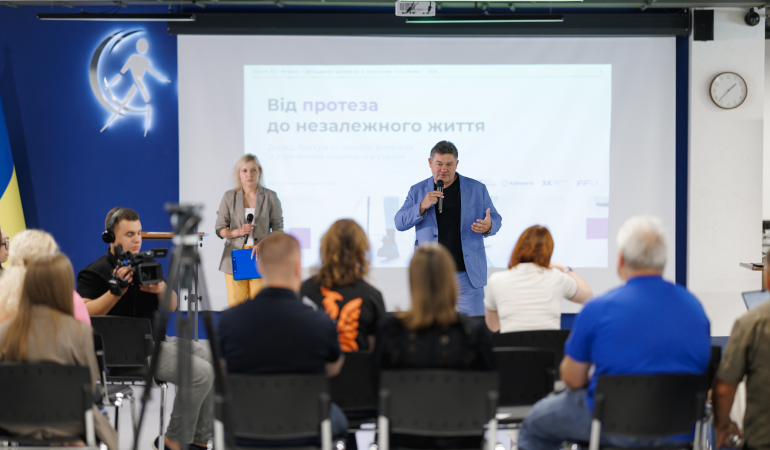
The findings were presented at the MCOP Ukraine prosthetics center to representatives of relevant ministries, veterans’ organizations, the civil society sector, and professionals working in prosthetics and rehabilitation. The study was conducted as part of the project “Go to the Future: Advocating for the Barrier-Free Integration of Veterans with Limb Loss,” with support from the Askold and Dir Fund, administered by ISAR Ednannia under the project “Strong Civil Society of Ukraine — a Driver of Reforms and Democracy,” funded by the Governments of Norway and Sweden.
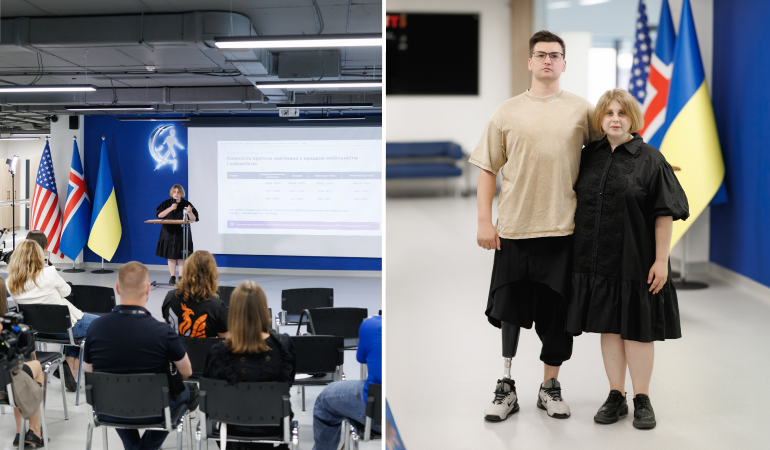
The findings were presented by Anna Lanchuk, Monitoring, Evaluation, Accountability and Learning (MEAL) Manager at Future for Ukraine and the wife of veteran Oleksandr Chaika, one of the first participants in the Foundation’s prosthetics program in the United States.
 Anna Lanchuk, Monitoring, Evaluation, Accountability and Learning (MEAL) Manager of the Foundation Future for Ukraine
“We assessed more than whether a person had received a prosthesis. We examined their entire journey afterwards: whether they can get around independently, use transportation, access services, work, and participate in community life. The data show that many gaps still remain between receiving a prosthesis and returning to an independent life.”
A prosthesis does not eliminate the need for assistance
Of the 204 respondents, 152 — or 74.5% — already have a prosthesis. However, 57 of them, or 37.5%, still need assistance or someone nearby for support at least occasionally when getting around.
Among prosthesis users who still require assistance, 77.2% encounter physical barriers every day. Among those who get around independently, the figure is 36.8%. This is a descriptive difference and does not establish causality, but it demonstrates the association between prosthetic outcomes, continued support, and the accessibility of the surrounding environment.
75.7% regularly encounter physical barriers
Of the 202 respondents who answered this question, 153 — or 75.7% — encounter physical barriers every day or several times a week. Among those who assessed the accessibility of public transportation, 56.4% rated it poorly. The figure rises to 71.4% among people living in villages and small settlements. However, because this subgroup was small, the result should be treated as an analytical signal rather than a generalizable finding.
Barriers also affect economic independence: 39.5% of respondents are not working because of their health. More than half rated access to essential information poorly: 56.9% for information about government benefits and official statuses, and 56.3% for information about employment and retraining opportunities.
Mental health support must be part of the recovery pathway
Nearly one in two respondents often or almost constantly experiences emotional fatigue (48.9%) or uncertainty about the future (45.7%). Anxiety is experienced with the same frequency by 33.2% of respondents, while 32.1% report experiencing isolation or loneliness.
Only 11.6% of respondents receive mental health support regularly, while another 24.1% receive it occasionally. At the same time, 40 of the 199 respondents who answered this question — or 20.1% — explicitly stated that they need mental health support but cannot access it.
Support must not end when a prosthesis is provided
Among prosthesis users who received at least four types of post-prosthetic support, 83.5% were satisfied with their prosthetic outcomes and 51.5% were employed. Among those who received between one and three types of support, the corresponding figures were 57.1% and 37.1%.
 Olena Nikolaienko, President of Future for Ukraine in the United States, strategist, and head of the Foundation’s international fundraising efforts
“A prosthesis can restore a person’s mobility, but it cannot restore independence on its own. It is important to us that the experiences of veterans are heard. We will therefore share the study findings with relevant ministries and local authorities so that accessibility policies are effective and reflect the needs of veterans and their families.”
About the study
The survey was conducted from April 13 to August 3, 2026, using non-probability online self-selection sampling. The data were analyzed at two levels: a descriptive analysis of the overall distribution of responses and a descriptive cross-analysis of subgroups based on prosthetic status, characteristics of limb loss, level of mobility, type of settlement, employment status, living conditions, and access to psychosocial support.
This approach helped identify differences and recurring combinations of barriers across groups of respondents. The findings describe the experiences of the 204 participants and cannot be directly generalized to all Ukrainian veterans. The observed associations are descriptive and do not establish cause-and-effect relationships.
This material was created by the Charitable Organization “Charitable Foundation ‘Future for Ukraine’” with the support of the Askold and Dir Fund, implemented by ISAR Ednannia, funded by Norway and Sweden. The contents of this publication are the sole responsibility of NGO «Name» and can in no way be taken to reflect the views the Government of Norway, the Government of Sweden and ISAR Ednannia.