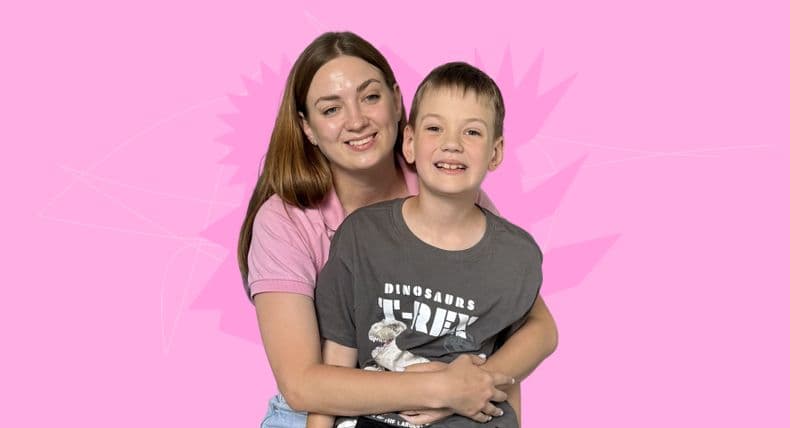
Children with autism spectrum disorders (ASD) are sensitive and often require special attention and society understanding. According to the National Health Service of Ukraine, as of 2024–2025, more than 21,000 children diagnosed with autism are officially registered in the country. This number continues to grow by approximately 30% every year.
How can we help children on the spectrum not only have a happy childhood but also gain a real chance for successful integration into society in the future? First, by understanding the issue and being tolerant. Second, by knowing what support is available. Timely corrective and developmental therapy is the basic support every family should be able to give for their child.
Unfortunately, because of the war, many Ukrainian families raising children on the spectrum cannot afford expensive sessions with specialists. Forced relocation, constant stress, and difficult living conditions often deprive parents of the most important resource — time, which their child desperately needs.
This is why charitable initiatives that provide access to professional support are especially important today. Thanks to the consistent support of our patron, Vadym Stolar, as well as other donors and partners, LEVCHYK has become a point of support for dozens of Ukrainian families. Among them is Anastasia from Kharkiv, who is raising her eight-year-old son Danylo, diagnosed with ASD.
“He didn’t speak at all at his 2,7 y.o.”
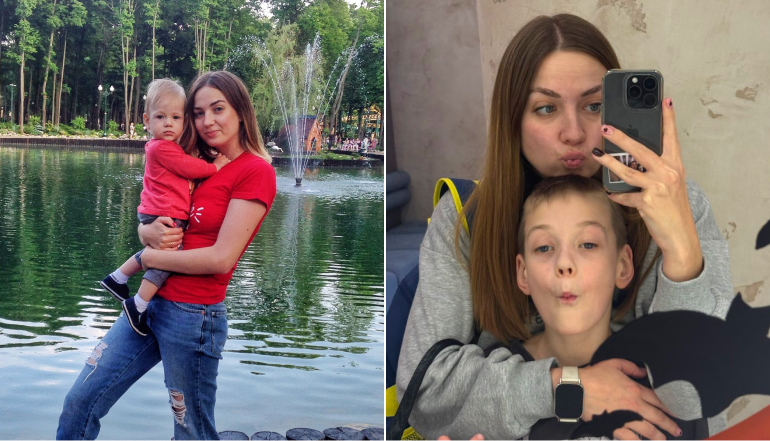
At the beginning of the russian full-scale invasion of Ukraine, the family was living in Kharkiv. Constant shelling was exhausting. Fortunately, Anastasia’s husband was offered a job in Lviv, and the family decided to relocate.
Only after the move was Danylo diagnosed with ASD. Before that, Anastasia reached out to many specialists, but she kept hearing the same words: “He’s still very young — he will grow out of it.”
Anastasia recalls that she herself struggled to believe such a diagnosis was possible, even though she noticed certain warning signs.
“We had a small chair on wheels, and he loved spinning it constantly. We thought it was funny, and filmed videos of him doing it. Or when he seemed to ignore me on purpose, not responding to anything. Only later, when I watched those old videos again, did I realize these were early signs of autism.”
The first person to raise serious concerns was Danylo’s grandmother. At two years and seven months old, he still wasn’t speaking at all. That’s when the parents began researching autism more deeply, visiting psychologists and completing assessments with their son.
However, no one confirmed the diagnosis at the time. Instead, they heard the same reassuring phrase again and again: “He’s fine — it’s just a speech delay.”
Anastasia admits that the real acceptance did not come during yet another appointment with a specialist. It came later, after moving to Lviv, when she was preparing documents related to her child’s disability status. Danylo was already five years old. And that was only the beginning of the family’s path.
“All the pieces of the puzzle finally came together. I realized that it was autism, and I started looking at everything differently. We had to work with it and move ahead.”
You’ve got a diagnosis. What comes next?
Autism is not a disease that can be cured, but rather a different way the nervous system functions. The earlier the diagnosis is made, the greater the chances that a child will successfully adapt to society and reach their full potential.
The confirmed diagnosis often comes as a shock to families. At the same time, it can also become a point of stability — the moment when parents finally begin to understand their child’s needs.
Supporting a child at this stage means consistent work — both at home and with specialists. What kind of therapy does a child on the spectrum need? Olha Hliuza, Head of the “Helping children” direction at the Future for Ukraine Foundation, explains:
“The first and most important is ABA therapy (Applied Behavior Analysis). It is considered a method based on studying behavior and understanding how the environment influences it. Children learn complex skills, such as dressing themselves up or asking to drink/eat. These skills are kept in small, manageable steps.”
Corrective therapy for children on the spectrum
Children with ASD often develop speech differently. Some do not speak at all. Some repeat phrases from cartoons (echolalia). Others may have a large vocabulary but struggle to maintain a conversation. That is why sessions with a speech therapist or speech pathologist are also essential. These specialists help initiate speech, work on articulation, and develop understanding of spoken language.
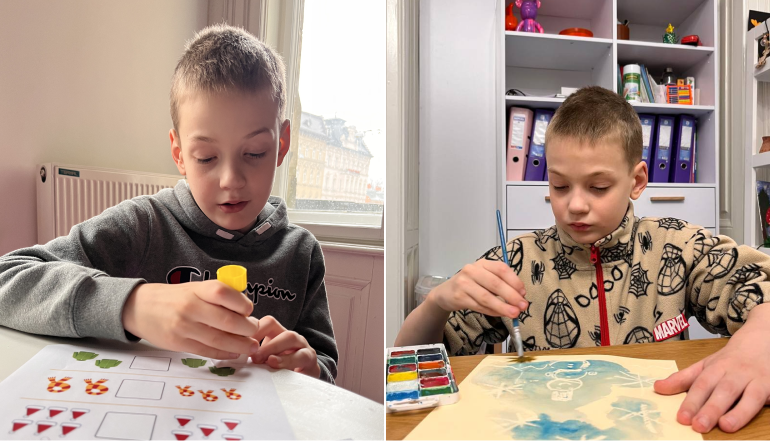
Sensory integration therapy is another important element. Many children with autism experience the world either “too loudly” or “too quietly.” Ordinary light from a lamp may seem painfully bright, and the touch of clothing may feel uncomfortable or even painful.
These sessions usually take place in specially equipped sensory rooms with swings, dry pools, weighted blankets, and various textures. This allows the child to receive necessary sensory inputs in a safe space.
Working with a psychologist is another important step. Through play therapy and social stories, children learn to recognize emotions — both their own and those of others. Psychologists also help children practice behavioral scenarios they may encounter in everyday life, for example, in a store, on a playground, or at school.
For Anastasia and Danylo, LEVCHYK SPECTRUM HUB became a real lifeline — a corrective support center for internally displaced children and children from frontline regions with autism spectrum disorders, where specialists work together with the children.
Anastasia has already begun noticing the first progress and believes it has become possible thanks to consistent therapy.
“Here, the sessions are regular and systematic. We see even small changes and notice progress. LEVCHYK really saves us. It’s free of charge and very professional. The people who work here support both the children and the mothers. We work together as a team — focused on results.”
The LEVCHYK center provides free corrective therapy for internally displaced children in Lviv and for children from the frontline area of the region and Mykolaiv.
To apply and learn about the required documents, please fill out the form on the project website.
You can also support the development of children on the spectrum by donating to provide corrective therapy sessions through the link.